
What Are Turkey Teeth and What Does the Treatment Involve
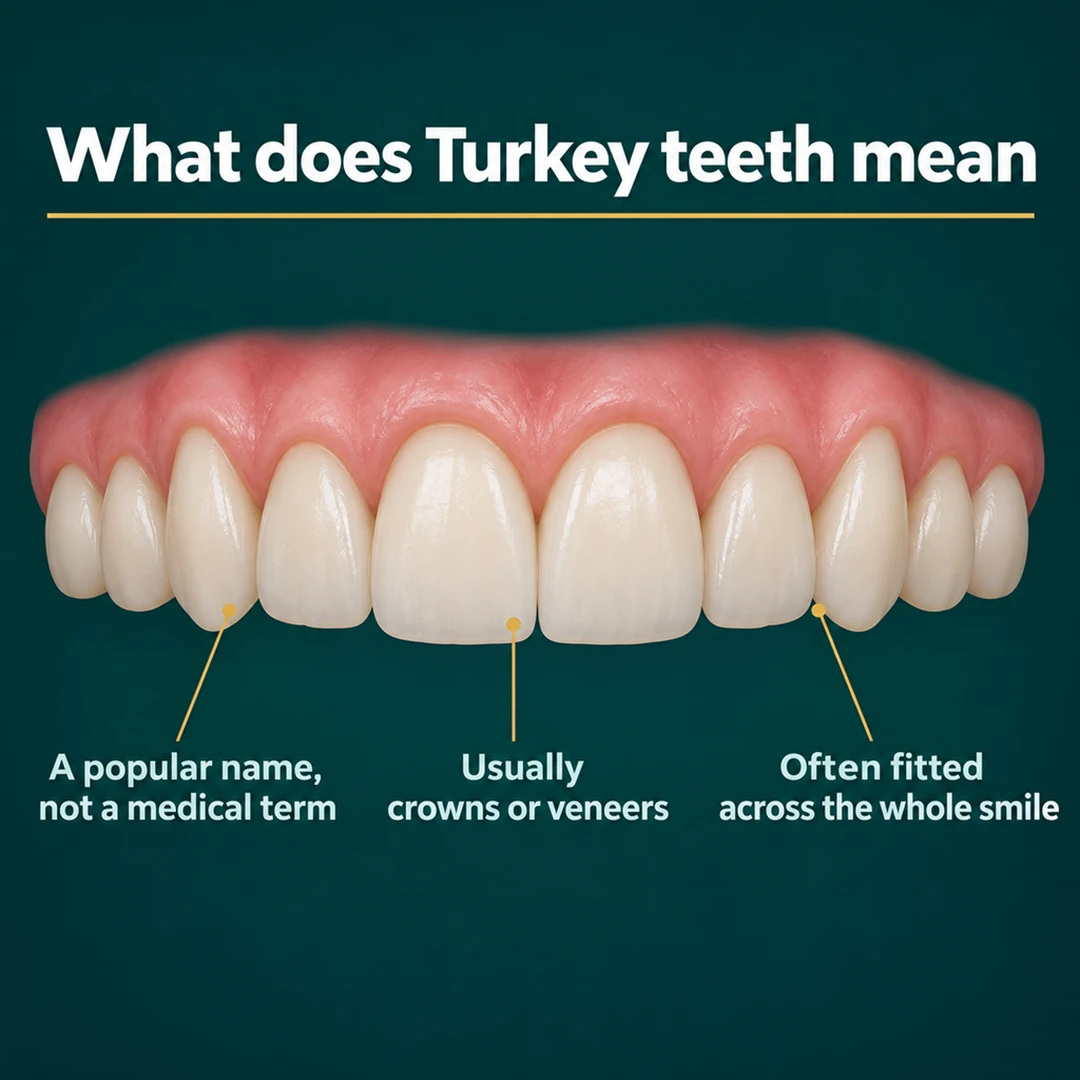
What are Turkey teeth? The phrase is a popular name for crowns or veneers fitted in Turkey, often across the whole smile. A crown covers the entire tooth, while a veneer covers only the front surface. Ceramic ones are made in a laboratory after the teeth are shaped and scanned.
Medically reviewed by Vijdan Aslanoğlu
What Does the Term Turkey Teeth Mean
Turkey teeth is a popular name for cosmetic dental work, usually crowns or veneers, that people have done in Turkey. It is a nickname rather than a medical term, so you will not find it on a dentist's chart. In the UK it is mostly used for a full set of bright, even teeth fitted over a short stay.
A 2025 review in the British Dental Journal looked at 131 UK newspaper articles on dental tourism. It reported that interest had grown, particularly among young people, after a wave of viral social media content. It also reported that tabloids often stigmatised people who had dentistry abroad.
We use the phrase the way patients do. What matters is what was done to each tooth, why it was done and who planned it.
Patient stories
How Do Patients Describe the Turkey Teeth Process
Patients describe their own experience at Er Dental Clinic. Individual results vary.
What Kind of Dental Work Do People Mean by Turkey Teeth
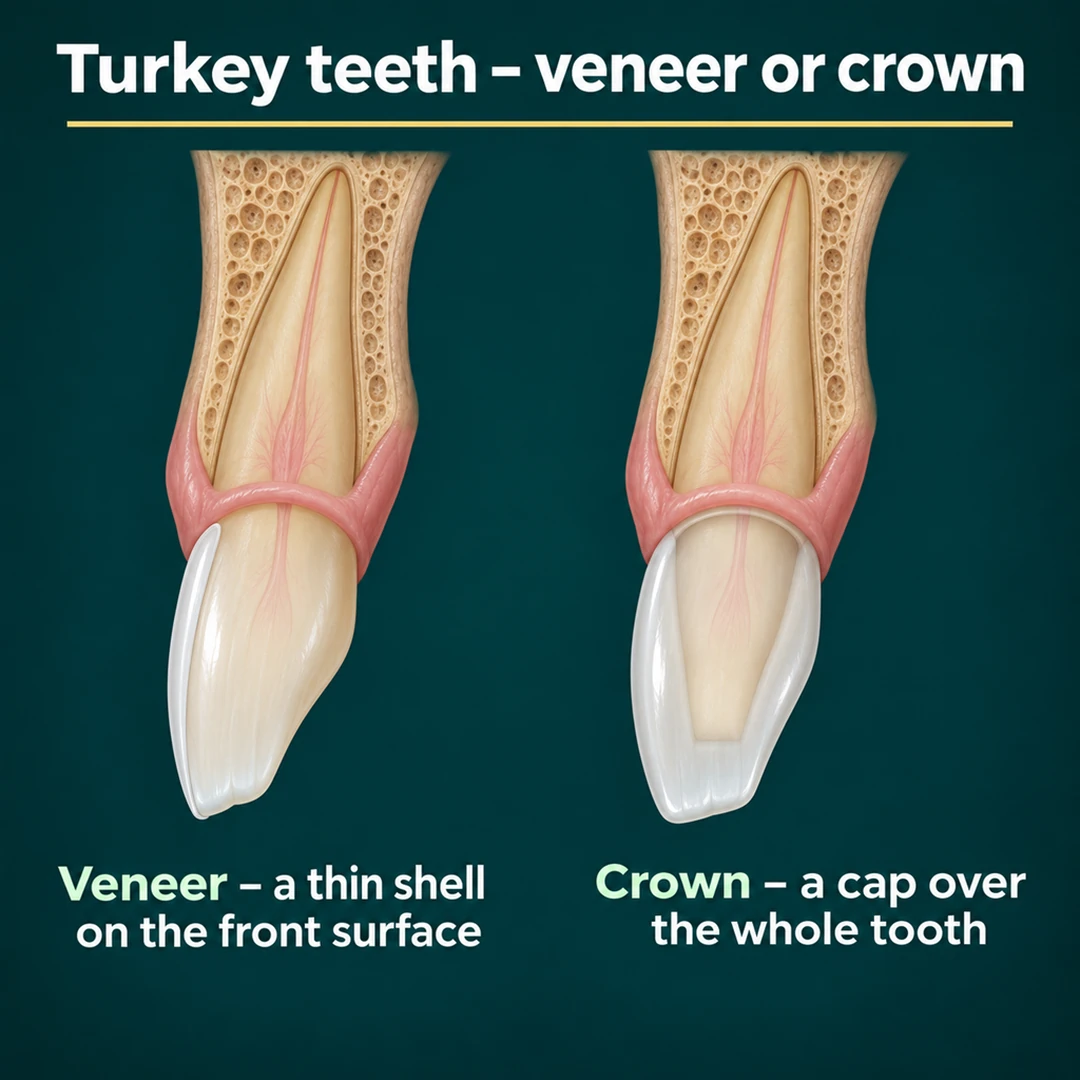
People usually mean one of two treatments. A crown is a custom-made cover that fits over a tooth, and a veneer is a thin shell bonded to the front surface only. Some patients have a mix, with crowns on weaker teeth and veneers on sound front teeth.
A dental crown suits a tooth that is broken, heavily filled or weakened. To make room for it, the tooth is shaped first. A dental veneer suits a tooth that is structurally sound but uneven, worn or discoloured, and the American Dental Association notes that veneer treatment is not reversible because some enamel is removed.
You may also see Hollywood smile used for the same kind of makeover. It is another popular label, and it tells your dentist very little. A plan only makes sense once someone has examined each tooth.
- Crown: covers the whole tooth
- Veneer: covers the front surface only
- Mixed plan: crowns where a tooth needs strength, veneers where it does not
What Are Turkey Teeth Made Of
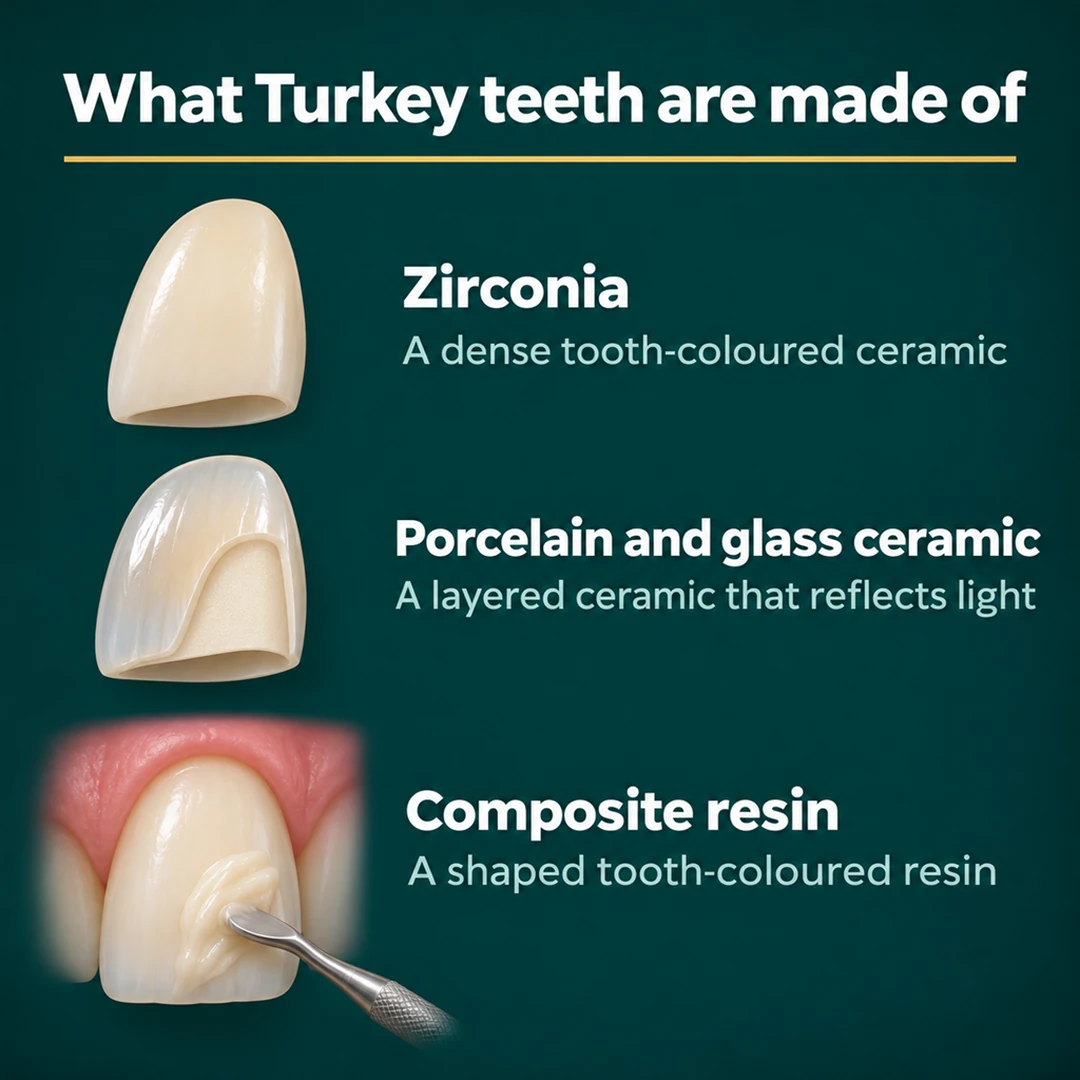
Turkey teeth are made from dental ceramics, most often zirconia or a glass ceramic such as E-max, and sometimes composite resin for veneers. Zirconia is a strong, metal-free ceramic, while E-max is a lithium disilicate glass ceramic, and each balances strength and translucency differently.
Cleveland Clinic describes zirconia as extremely durable, able to withstand heavier forces than other ceramic crowns. It also notes that all-ceramic or porcelain crowns mimic the appearance of tooth enamel more than any other crown type. That is why back teeth often lean towards zirconia and front teeth towards a more translucent ceramic.
A zirconium crown is milled from a solid block and then shaded to blend with its neighbours. Our E-max crowns and veneers are made with Ivoclar materials, while composite is built up directly on the tooth. To compare the two ceramics properly, our guide on zirconia or E-max sets them side by side.
Why Do Some Turkey Teeth Look Too White
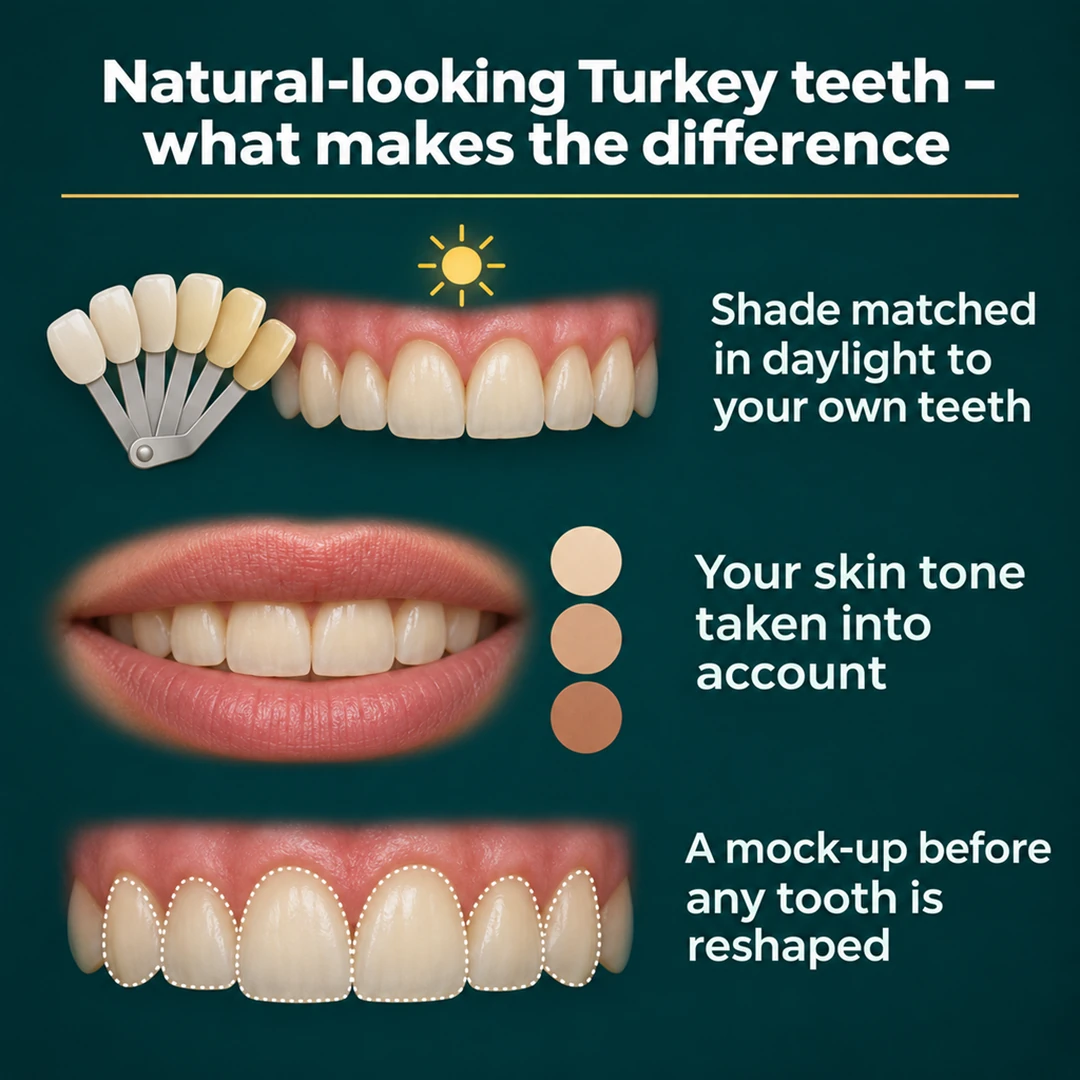
Some Turkey teeth look too white because the shade was chosen much lighter than the person's other teeth and does not suit their skin tone. A shade picked from a photograph, rather than matched in daylight against your own teeth, can end up looking too light. A more opaque material on a front tooth can add to that effect.
The final colour is agreed together with your dentist, not fixed in advance.
We choose the shade in daylight, against your own teeth and with your skin tone in mind. A mock-up on your own teeth lets you preview the planned shape and shade before any tooth is reshaped, and you can ask for changes at that point.
How Do You Get Turkey Teeth in Istanbul, Step by Step
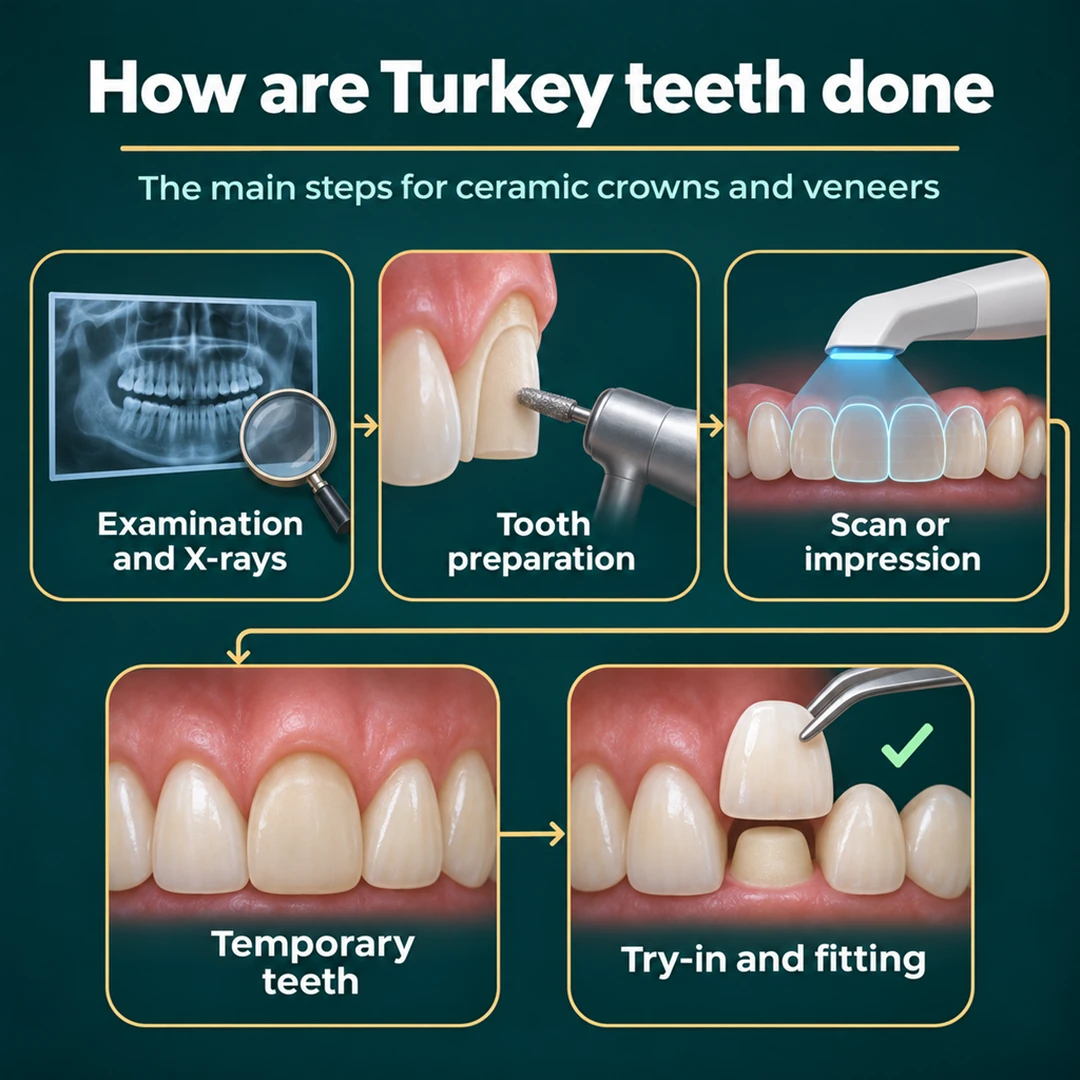
For ceramic crowns and veneers, the process has five main steps: an examination with X-rays, tooth preparation, a digital scan or impression, temporary restorations and a fitting of the final ones. Most people need two main visits, several working days apart, while the laboratory makes the restorations. Composite veneers can often be built up directly in a single appointment.
- Examination and X-rays: your dentist checks the teeth, gums and bone before anything is planned.
- Tooth preparation: the tooth is shaped so the crown or veneer has room to fit without changing your bite.
- Digital scan or impression: this records the shape the laboratory works from.
- Temporary restorations: you wear these while the final ones are made.
- Try-in and fitting: fit, shade and bite are checked before the final restorations are cemented or bonded.
Preparation is carried out under local anaesthesia, and the procedure itself is not usually painful once the area is numb. Most patients go back to normal eating and speaking within a day or two of the temporary restorations being fitted. Your dentist confirms the exact schedule for your own plan.
Who Are Turkey Teeth Not Suitable For
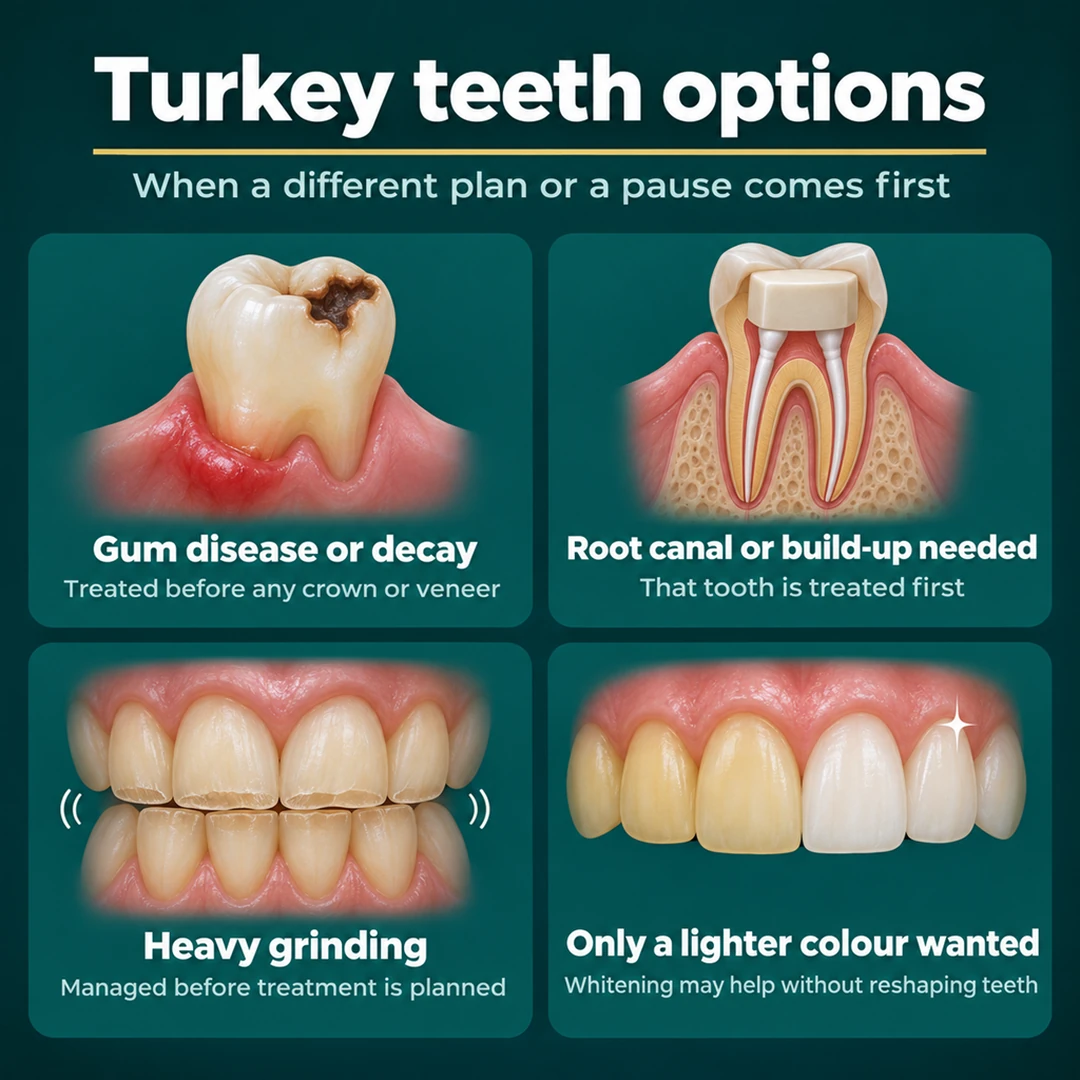
Turkey teeth are not suitable for everyone, and an honest assessment sometimes ends in a simpler plan or no cosmetic work at all. A tooth with decay, gum disease or a failing root filling usually needs that problem treated before any crown or veneer. Healthy teeth that are only slightly uneven often need far less than a full set.
These situations usually need a different plan or a pause first:
- Active gum disease or untreated decay
- A tooth that needs root canal treatment or a filling build-up
- Heavy grinding that has not been managed
- Healthy teeth where the only wish is a lighter colour, which whitening may give without reshaping the teeth
The General Dental Council advises that the dentist carrying out your assessment should ask for your full medical history. Tell us about any medicines or conditions, because they can change the plan. Choosing the least amount of tooth reduction the case actually needs is part of how we plan, rather than defaulting to crowns on every tooth.
How Is a Turkey Teeth Procedure Planned Before You Travel
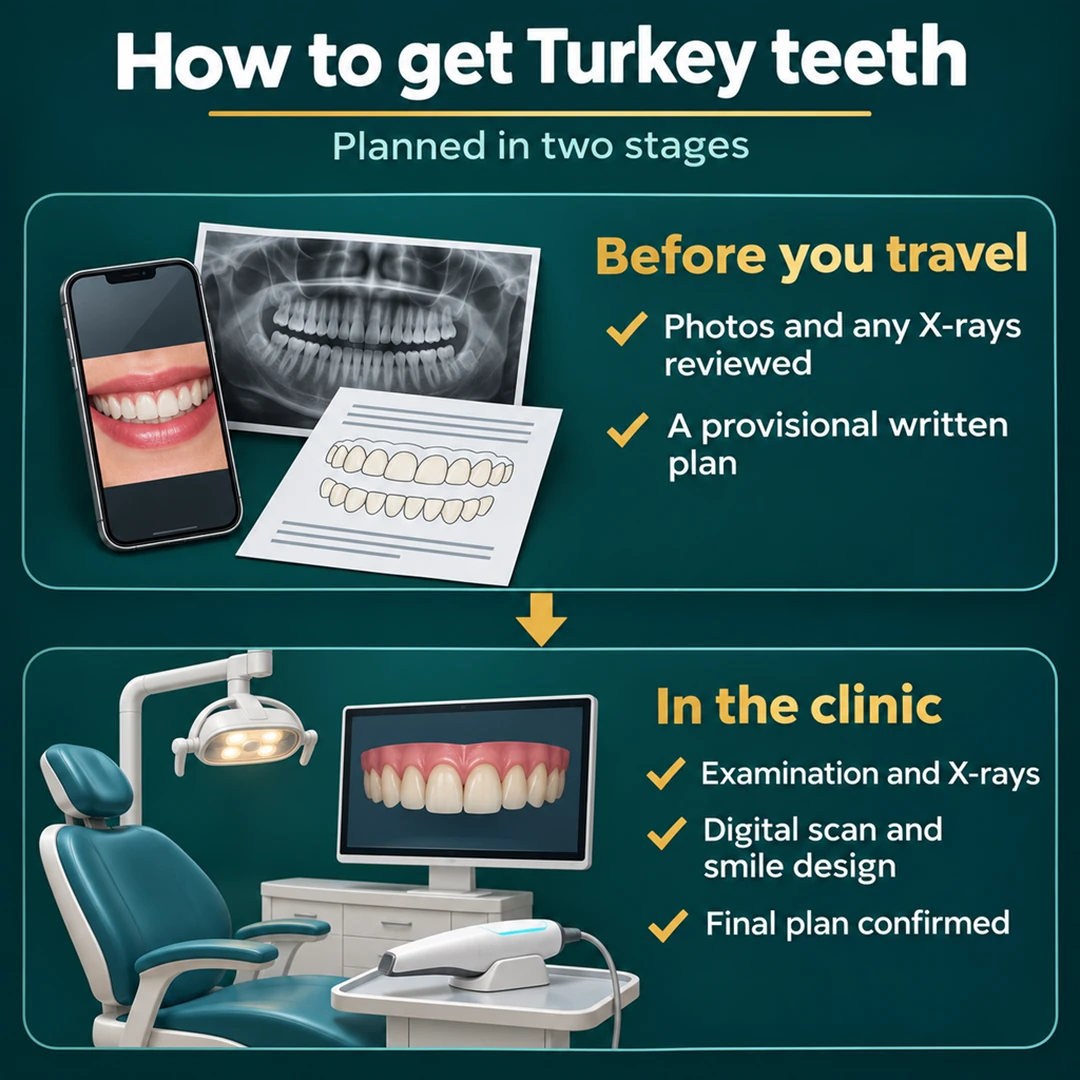
A Turkey teeth procedure is planned in two stages. Before you travel, our dentists review your photos and any X-rays and prepare a provisional written treatment plan stating the material, the number of teeth, the expected length of your stay and the price. An in-clinic examination and X-rays then confirm the final plan.
We use 3Shape digital scanning, which in many cases replaces traditional impression trays. A panoramic X-ray and, where your dentist needs it, a CBCT scan are part of planning. Digital smile design lets you see the proposed shape and length before any enamel is prepared.
The plan also settles how many teeth to treat. For some people that is a handful at the front, and for others it is a full set. Your written plan states which material is proposed and why, so you can weigh it against any other quote you hold.
Treatment is planned by Dt. Vijdan Aslanoğlu, a dentist who works on crowns and veneers at Er Dental Clinic, alongside our other general dentists. The price band below shows our zirconia crown price per unit and for a 20-crown package, and your own total is written into your plan before you book. For other materials, our price list shows the per-unit price of each crown and veneer.
What Do Real Patients' Results Look Like
The photos in this section show real Er Dental Clinic patients before and after treatment. Each case is different, so a photo is not a promise of how your own teeth will look. Results vary from person to person, depending on the teeth you start with and the plan you choose.
Use the photos to judge colour, shape and how natural a smile looks next to the person's face. Then ask us for cases similar to yours. More patient videos and written comments are on our reviews page.
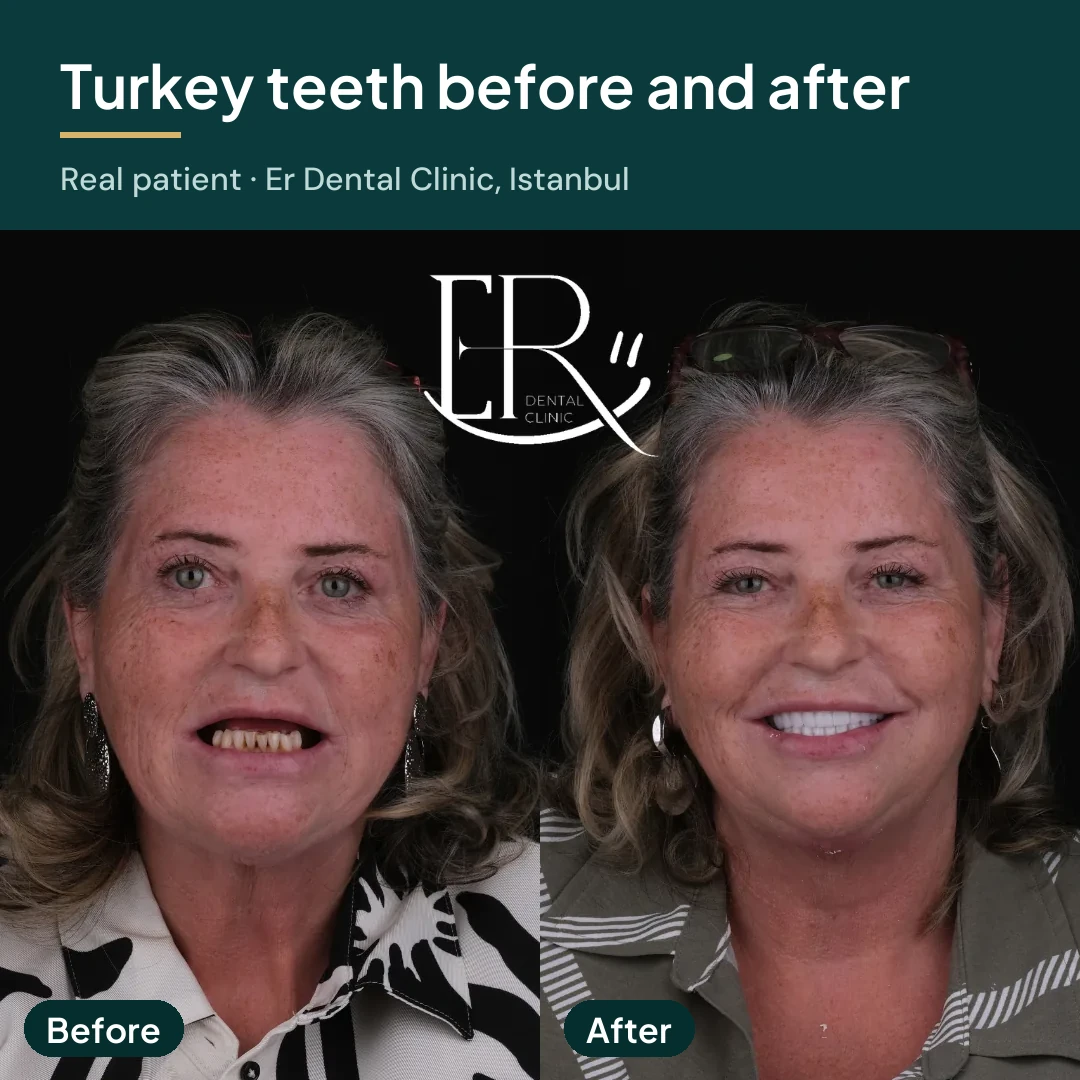
Real patients
What Do Real Smiles Look Like Before and After
Patients describe their own experience at Er Dental Clinic. Individual results vary.
What Should You Check Before You Book
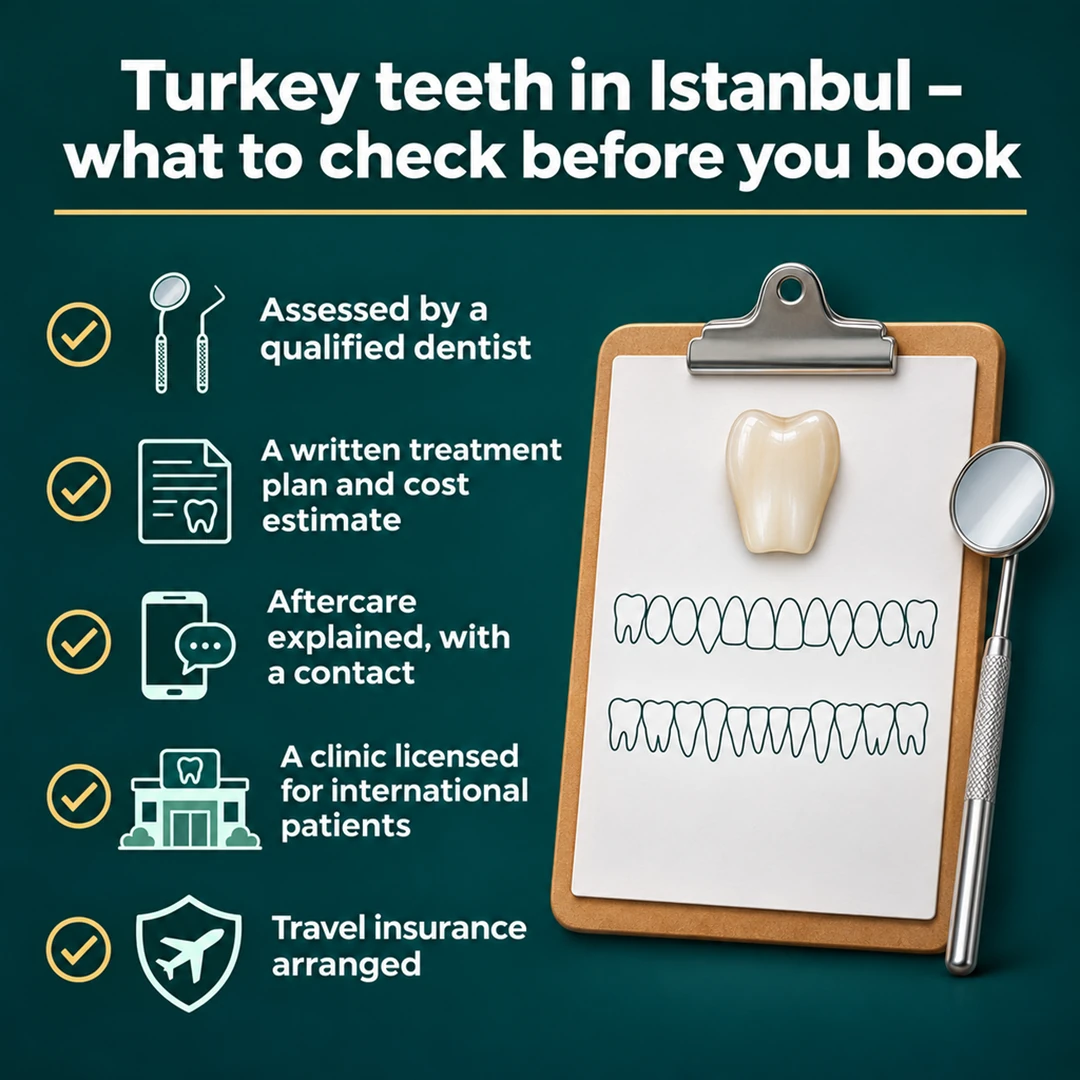
Before you book, check that a dentist has assessed your teeth, that you have a written plan, that aftercare is explained and that the clinic is licensed to treat international patients. The General Dental Council advises that you should always be assessed by a qualified dentist before being given a treatment plan and cost estimate.
The NHS treatment abroad checklist adds three more points: be clear how your aftercare will be coordinated, understand the possible complications and side effects, and have appropriate travel insurance. It also suggests discussing how to transfer your medical notes to the overseas team.
- Ask what aftercare is provided and who to contact if something feels wrong
- Ask how much of each tooth will be reshaped and why
- Ask what is included for travel
You can start with a free online consultation. Send photos of your teeth, and any X-ray you have, on WhatsApp or through the contact form, and our dentists reply with a provisional written plan and an estimated price. The final plan and cost are confirmed only after an in-clinic examination and X-rays.
Airport, hotel and clinic transfers are part of our treatment packages, and hotel accommodation depends on the package you choose. Er Dental Clinic holds a Ministry of Health International Health Tourism Authorisation Certificate (no. ST-6264), which you can verify on the e-Devlet document verification service.
Ask a Dentist About Turkey Teeth in Istanbul
If you are thinking about crowns or veneers in Istanbul, send us clear photos of your teeth, and an X-ray if you have one. Our dentists reply with a provisional written plan at no charge, and you can ask them anything before you decide.
Turkey Teeth Questions Patients Ask
Can Turkey teeth look natural?
Yes, when the shade, shape and length are matched to your face and to the teeth around them. Natural results come from planning more than from the material alone. Cleveland Clinic notes that all-ceramic or porcelain crowns mimic the appearance of tooth enamel more than any other crown type, and a mock-up lets you check the look first.
Do Turkey teeth hurt?
Not usually during treatment, because the teeth are prepared under local anaesthesia and the area is numb. Some mild sensitivity to hot or cold is common for a few days afterwards and usually settles on its own. Your dentist explains what to expect and when to get in touch if it does not settle.
How is the cost of Turkey teeth worked out?
The cost depends on how many teeth are treated, whether each one needs a crown or a veneer, and which material suits it. Our price list shows the per-unit price of each crown and veneer material. Your provisional plan gives a figure for your own teeth, and the final cost is confirmed after an in-clinic examination and X-rays.
Can you get Turkey teeth on just a few teeth?
Yes. You do not need a full set. Treatment can be a single crown or a few veneers, and your dentist decides tooth by tooth after an examination and X-rays. The crowns or veneers are shaded to blend with your natural teeth.
What is the difference between Turkey teeth and a Hollywood smile?
Very little in practice. Both are popular labels for a cosmetic makeover, usually crowns, veneers or a mix across the visible teeth. Turkey teeth is the UK nickname for that work done in Turkey, and the plan matters more than the name.
Can you eat normally with Turkey teeth?
Yes, for most people within a day or two of the temporaries going in. Until the final crowns or veneers are fitted, avoid very hard or sticky foods, because temporaries are fixed more loosely than the final restorations. Avoid biting directly into ice or hard sweets with any ceramic crown or veneer.
References
- Crowns — American Dental Association (MouthHealthy), 2026
- Veneers — American Dental Association (MouthHealthy), 2026
- Dental Crowns: Types, Procedure & Care — Cleveland Clinic, 2023
- Crowns — Oral Health Foundation, 2026
- Going abroad for dental treatment — General Dental Council (GDC), 2026
- Treatment abroad checklist — NHS, 2023
- Contemporary dental tourism: a review of reporting in the UK news media — British Dental Journal (PubMed PMID 40021870), 2025
- Clinical Outcomes of No-prep Veneers and Conventional Veneers: A Systematic Review — Journal of Contemporary Dental Practice (PubMed PMID 42607000), 2025
Related Pages
Get your free online consultation
Send us a short message with your question, and photos or X-rays if you have them. Our dentists review your case and reply with a personalised treatment plan — send it by e-mail or WhatsApp — your message is not stored on our server.
A short sentence is enough; no medical terms needed. What you write is only sent when you send it; this page stores no information.