
Are Turkey Teeth Shaved Down and Why Do Crowns Need It
Turkey teeth shaved down describes teeth reshaped to make room for crowns or veneers. A crown needs the whole tooth reduced so it fits over it, while a veneer usually needs only a thin layer of enamel from the front. How much is removed depends on the tooth, the material and the plan.
Medically reviewed by Vijdan Aslanoğlu
Why Are Turkey Teeth Shaved Down for Crowns
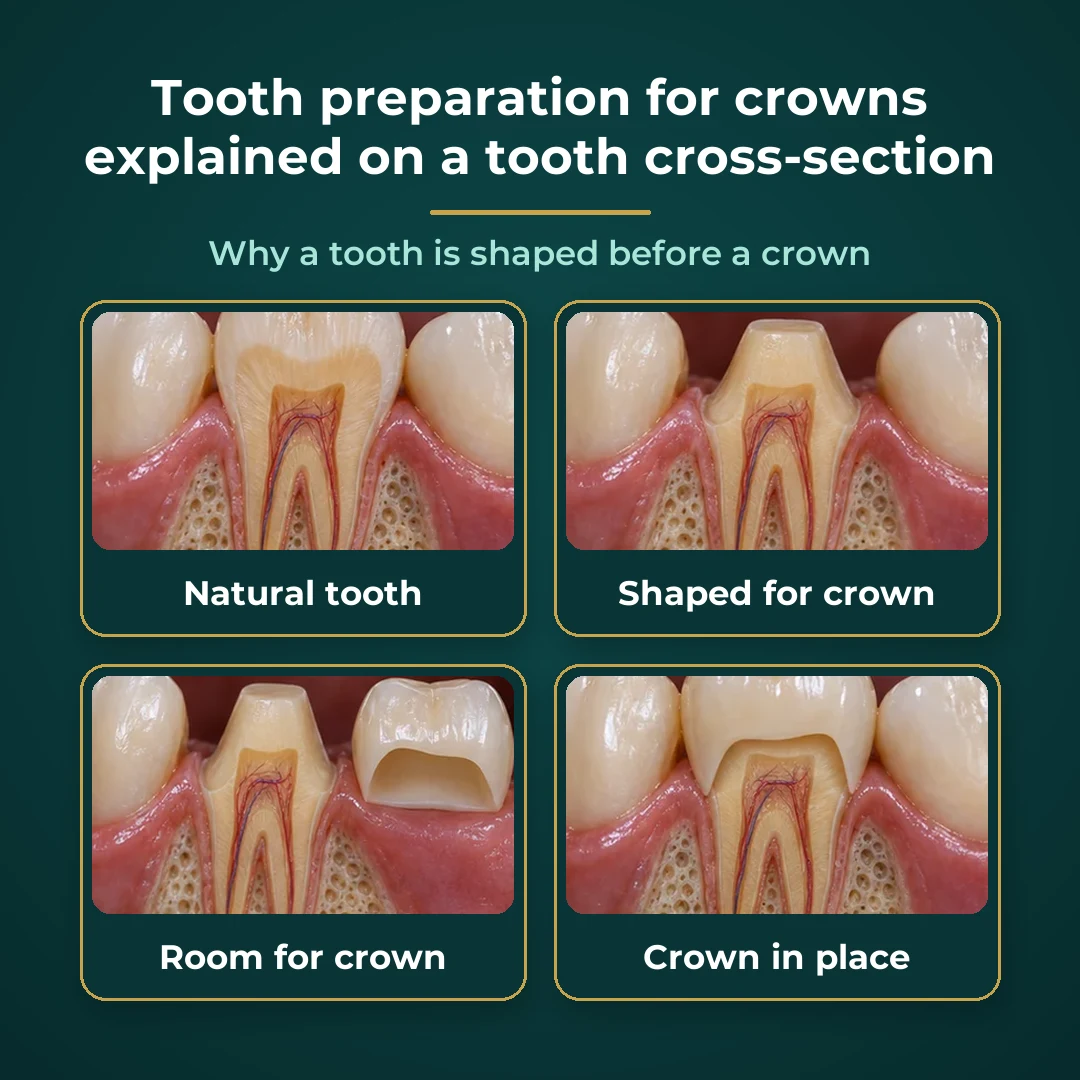
A dental crown is a cover that fits over the whole tooth, so the tooth is shaped first to give the crown room without making the tooth bulky or changing your bite. The Oral Health Foundation says the tooth is shaped to make space for the crown, and Cleveland Clinic notes that some enamel has to be removed.
This is true of crowns made anywhere, not only in Turkey. The UK press often uses the phrase for cases where teeth were prepared more heavily than they needed to be, so the useful question is how much is taken and why. If the term is new to you, our guide on what are Turkey teeth explains the basics.
Leeds Teaching Hospitals describes the first appointment for a crown or veneer as spent re-shaping the tooth, with a temporary crown fitted to protect it before you leave. At our clinic a digital scan or impression then records the prepared tooth, and the final crown is tried in to check fit, shade and bite before it is cemented.
Patient stories
What Do Patients Say About Their Visits at the Clinic
Patients describe their own experience at Er Dental Clinic. Individual results vary.
Do Turkey Teeth Veneers Need the Teeth Filed Down
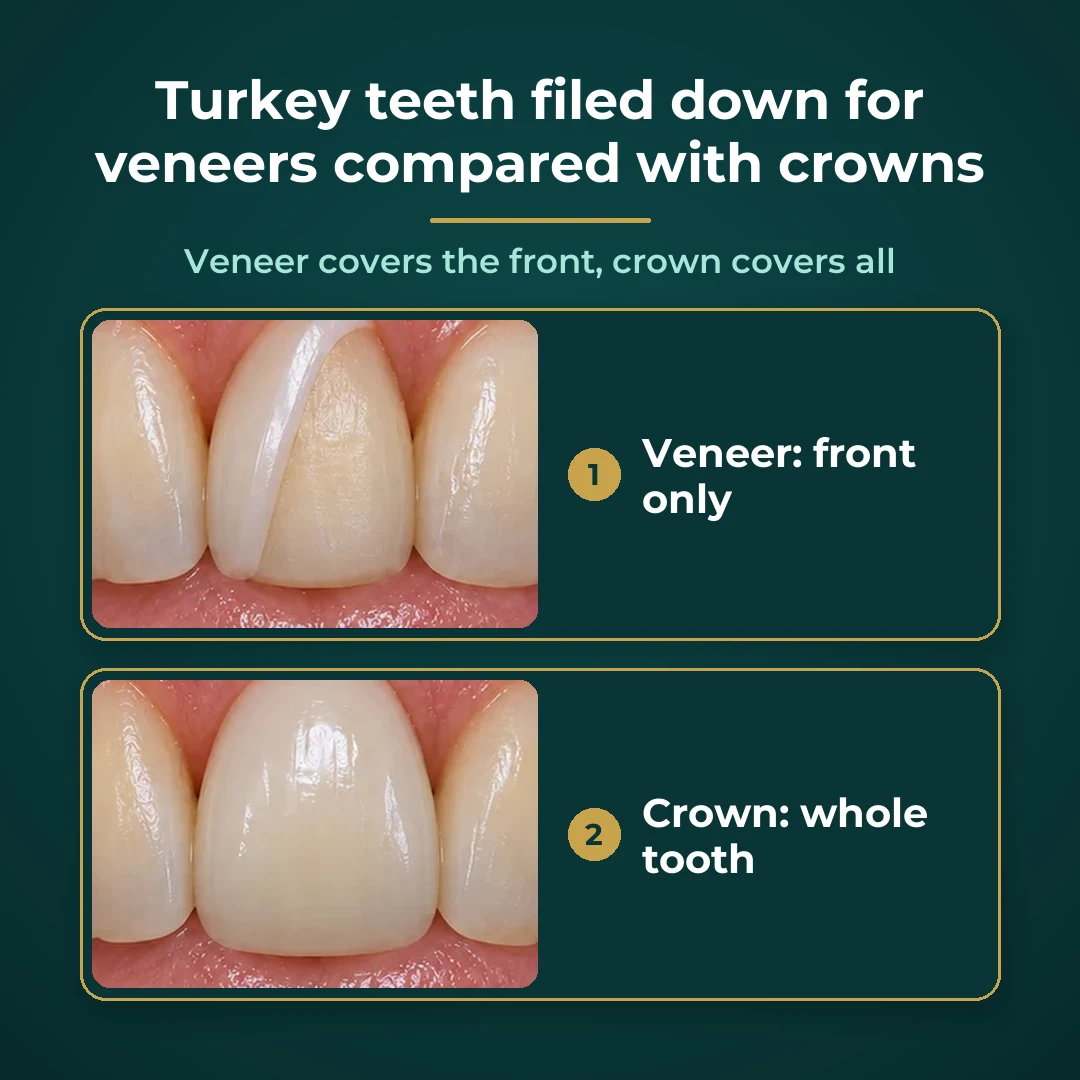
Most ceramic veneers need a thin layer of enamel taken from the front of the tooth, which is far less than a crown needs. The Oral Health Foundation describes a small amount of enamel being removed so the veneer does not feel bulky. Some ultra-thin options remove little or none, and they do not suit every tooth.
A dental veneer covers only the front surface, while a crown covers the whole tooth. The American Dental Association notes that veneer treatment is not reversible because enamel is removed to place one.
How much enamel goes depends on the tooth, the material and how much the shape or colour has to change. A small tooth that sits slightly back may need very little, while a tooth that already sits forward may need a little more to avoid a bulky look. Your dentist should be able to show you the plan for each tooth.
Our veneer plans are built around keeping as much natural enamel as the chosen material allows. Reducing healthy teeth to small stumps is not part of a veneer plan.
Can You Get Turkey Teeth Without Shaving
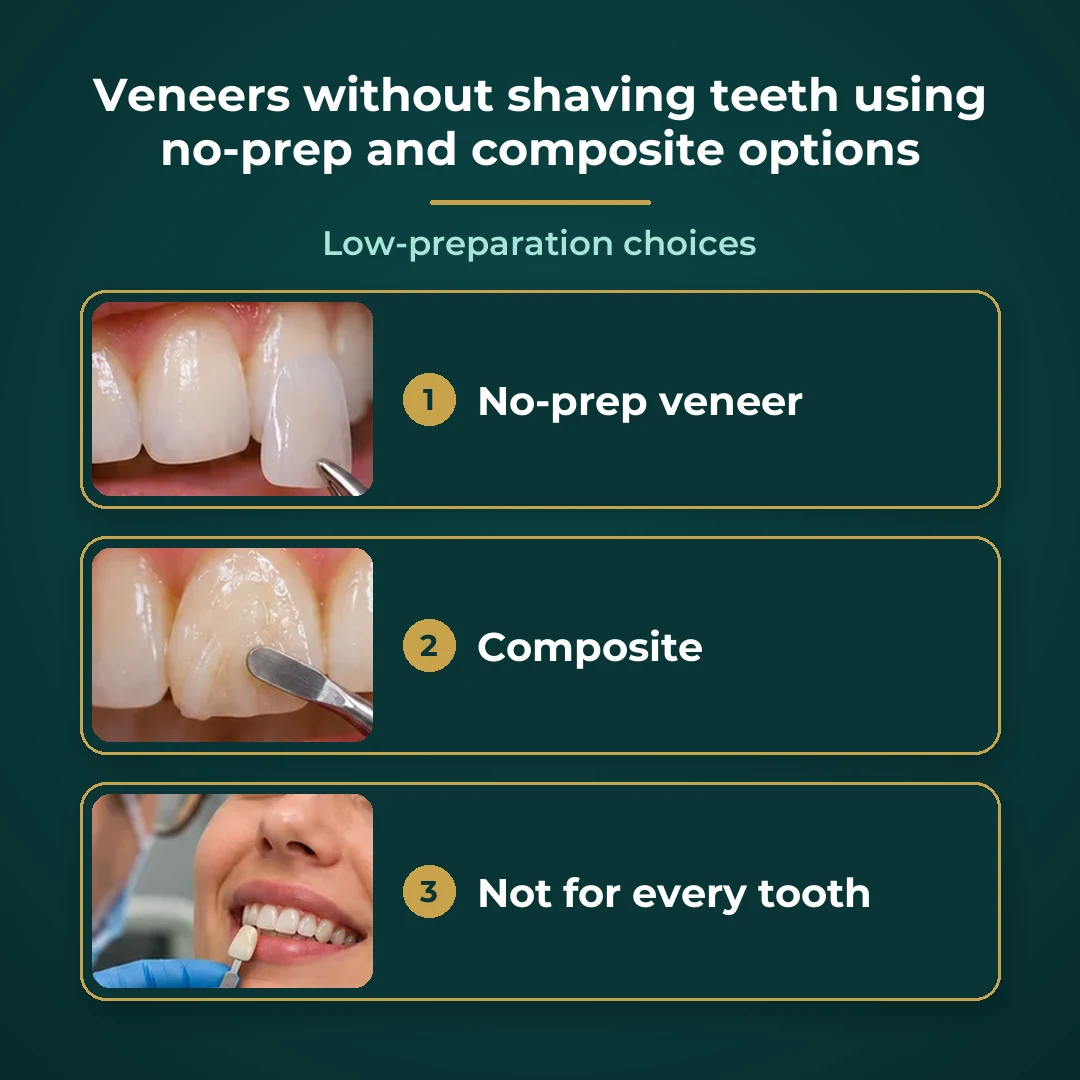
Sometimes. Ultra-thin no-prep veneers are bonded to the front of a tooth with little or no enamel removed, so they can suit some healthy teeth. They cannot replace a crown on a broken or heavily filled tooth, and a thin shell can look bulky on a tooth that already sits forward.
Lumineers is one brand of this kind of veneer, and the wider group is called no-prep or minimal-prep veneers. A composite veneer is another low-preparation option. The resin is built up on the tooth, often with little or no enamel removal, and it can be repaired, but it stains and wears sooner than ceramic.
A 2025 systematic review compared no-prep and conventional veneers and found only four studies that met its criteria, so the evidence is still limited. No-prep veneers are usually not the first choice in these situations:
- A tooth that already sits forward or looks prominent
- Noticeable crowding or rotation
- A tooth that needs strength rather than a thin cover
Can You Get Your Teeth Shaved Down Safely
Yes, tooth preparation is a routine part of dentistry when it is planned and kept to what the case needs. It starts with an examination and ends with a clear explanation of how much of each tooth will be reshaped and why. Reshaping cannot be undone, so that decision deserves time.
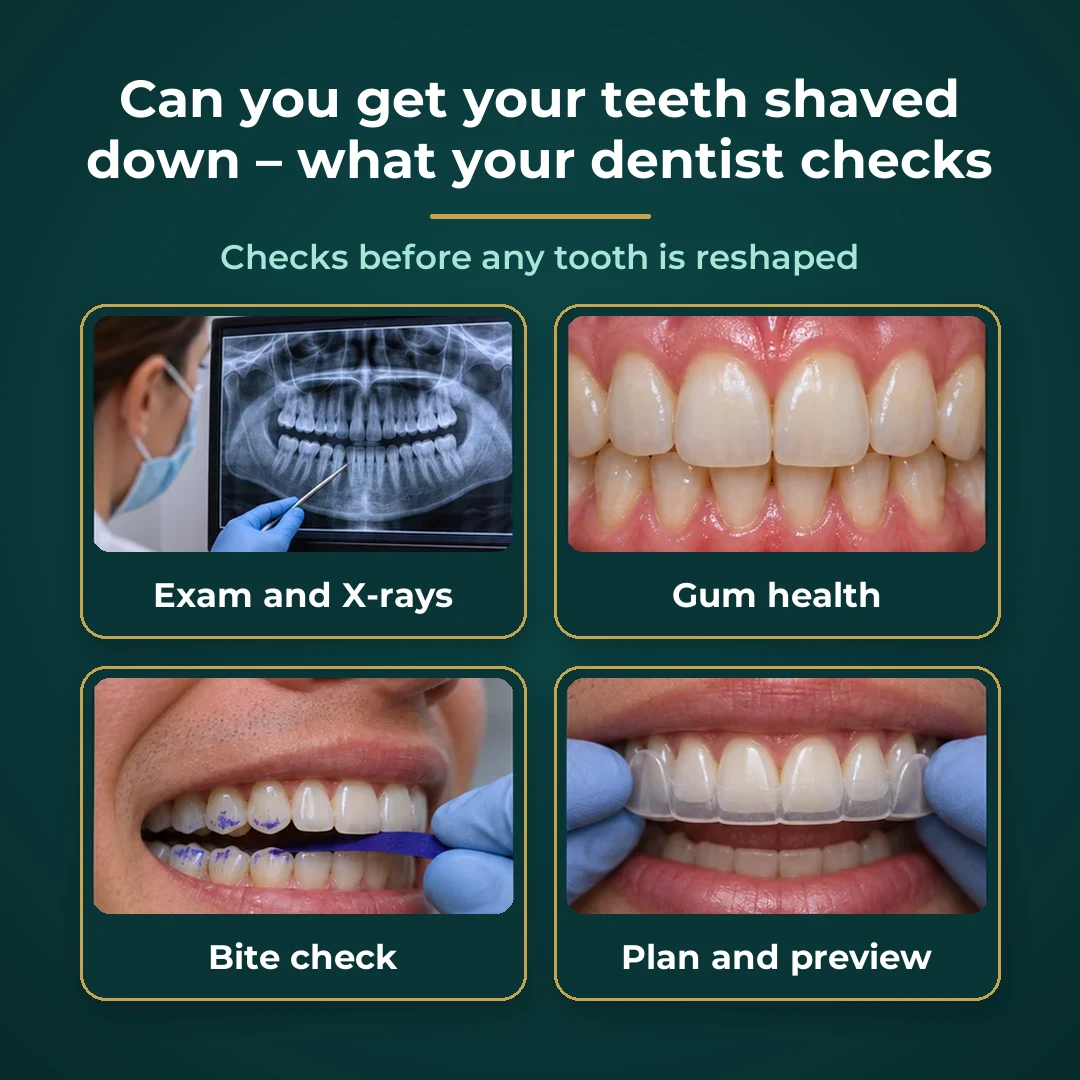
Before any tooth is reshaped, a careful plan checks several things:
- Decay, gum health and how your teeth bite together, with gum inflammation treated first so crown edges sit on healthy tissue
- Whether root canal treatment or a filling build-up is needed first
- Whether a gentler option such as whitening, bonding or a no-prep veneer would do
- How much of each tooth will be reshaped, and the reason
Be cautious of any plan that proposes heavy reduction of healthy teeth without explaining less invasive alternatives. Many of the worries people read about under the name Turkey teeth come from healthy teeth being reduced far more than was needed, and our guide to Turkey teeth gone wrong covers the warning signs.
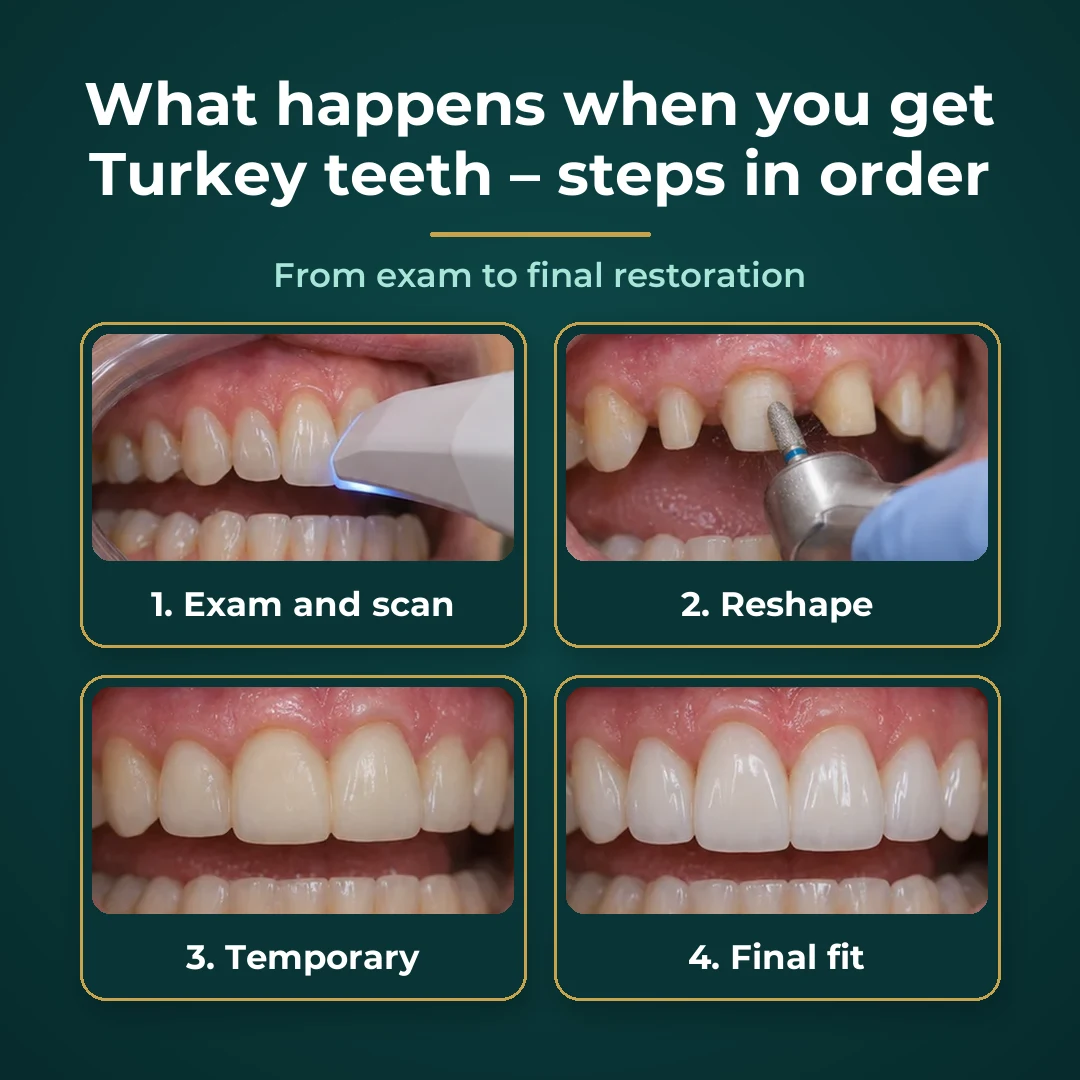
What Happens When You Get Turkey Teeth
First your dentist examines your teeth and takes X-rays. Each tooth that is getting a crown or ceramic veneer is then reshaped under local anaesthesia, recorded with a scan or impression, and protected with a temporary restoration while the laboratory makes the final one.
We use 3Shape digital scanning, which in many cases replaces traditional impression trays. The prepared tooth and the teeth around it are recorded so the restoration can be made to fit closely. Composite veneers differ, because the resin is shaped directly on the tooth, often in a single appointment without laboratory work.
What you notice at each stage is usually quite ordinary:
- During preparation: the area is numb, and the procedure itself is not usually painful once it is.
- Between visits: chew on the other side where possible and avoid very sticky or hard foods, because a temporary is cemented more loosely.
- After the final fit: mild sensitivity to hot and cold is common for a few days and usually settles by itself.
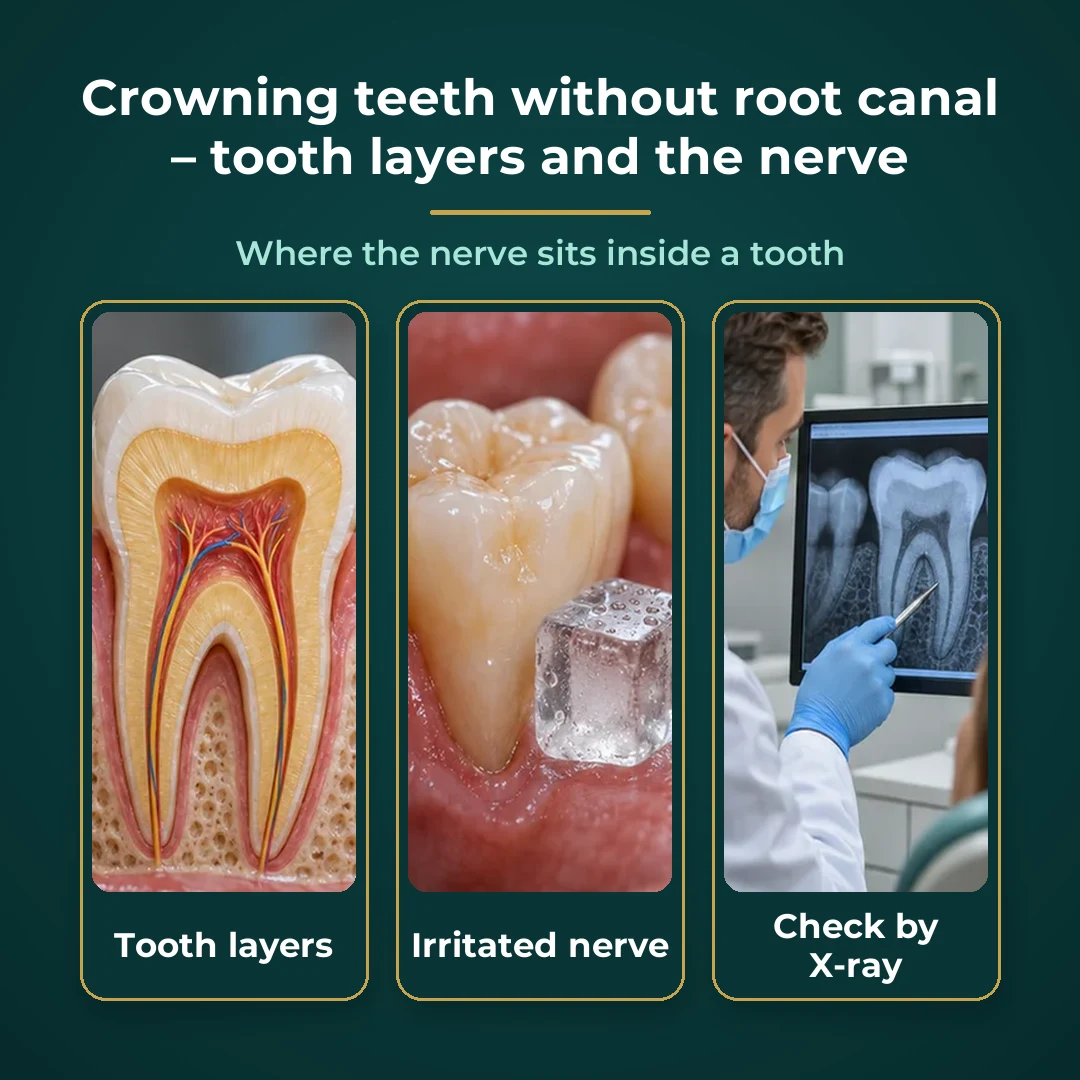
Does Shaving Teeth Down Damage the Nerve
Preparation does not usually damage the nerve, but it can irritate it, especially in teeth with deep decay, large old fillings or earlier injury. A 2022 systematic review of crown and bridge supports found that the large majority of vital teeth stayed free of nerve or root-tip problems over 5 to 20 years, though all the studies were observational.
Lingering sensitivity to hot or cold, or pain when you bite, may point to an irritated nerve, and a dentist can confirm this after an examination and X-ray. An infected or inflamed nerve should be treated with root canal treatment before the crown is made, not after. Our crown pages list nerve irritation as a possible drawback, and in a small number of teeth it may later need root canal treatment.
A 2002 laboratory study on model teeth, which measured how much tooth different preparations remove, notes in its background that conserving sound tooth structure helps preserve vitality and reduce sensitivity after preparation. That is the reason we aim to remove only what the chosen material needs.
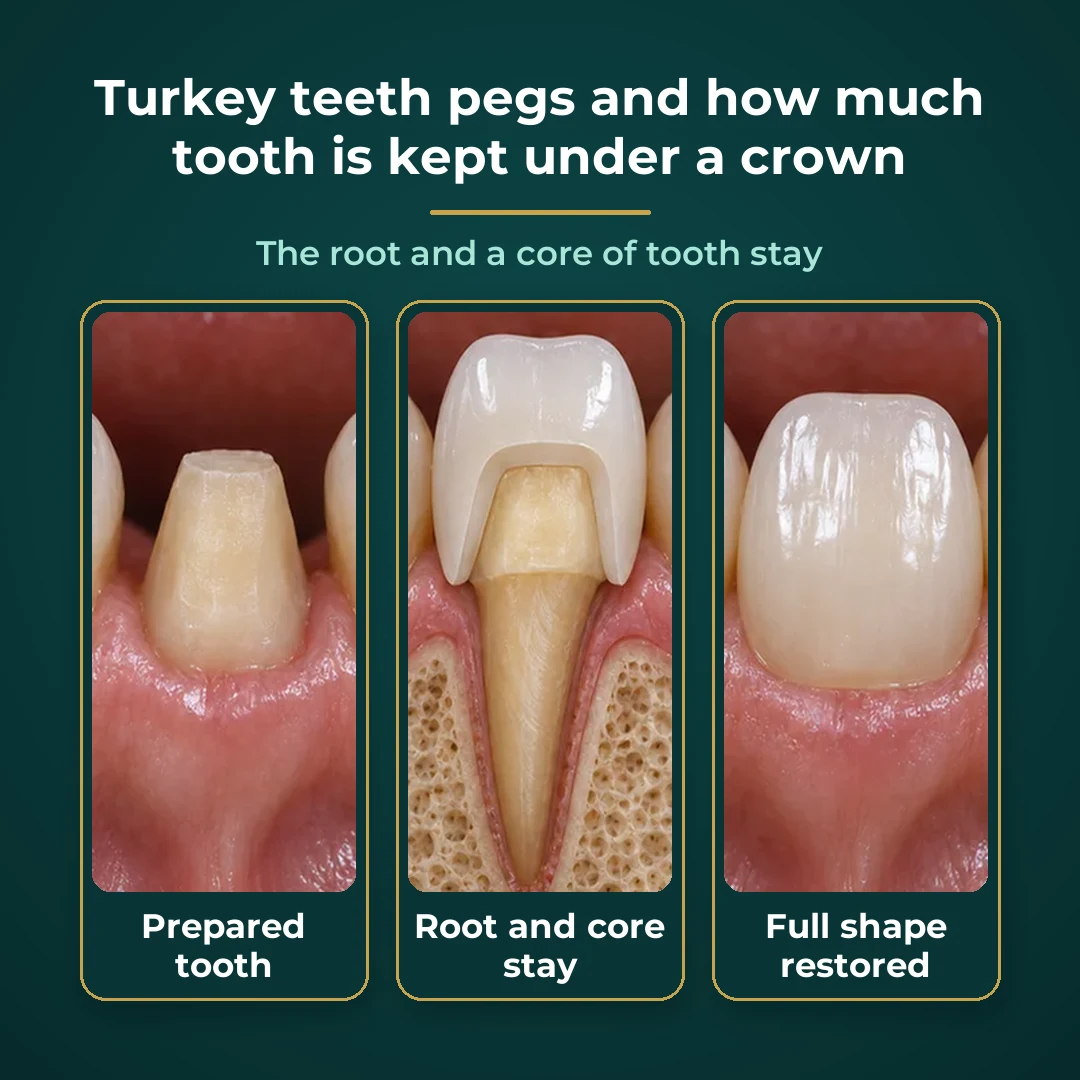
Are Turkey Teeth Really Shaved Down to Pegs
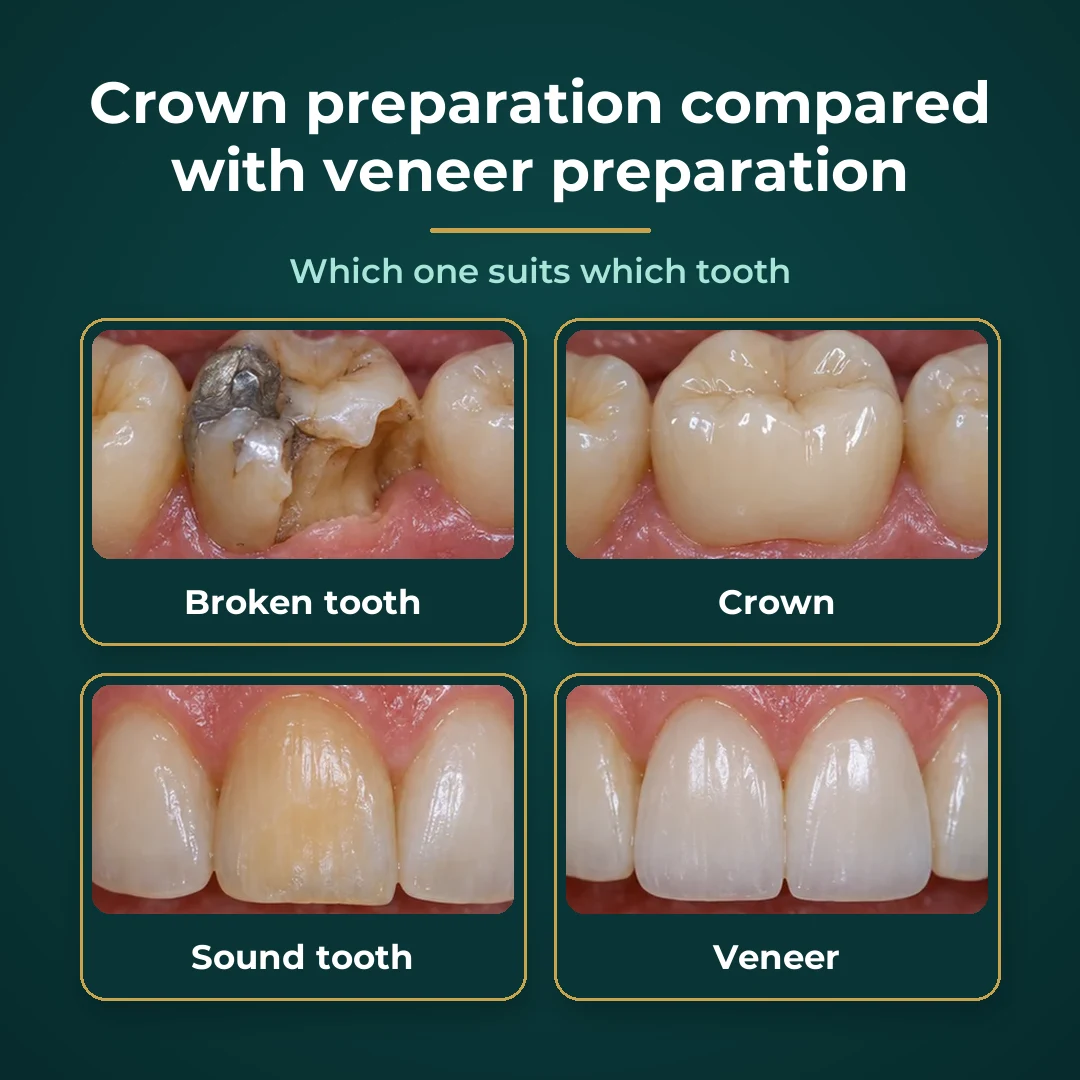
Not in a well-planned case. A prepared tooth is smaller and more tapered than the finished crown, and that is what the word peg describes, but the root stays in the jaw and a core of natural tooth stays under the crown. The crown then restores the full size and shape.
A 2002 laboratory study on resin model teeth reported that crown preparations removed a much larger share of the visible part of the tooth than veneer preparations did. The figures came from models rather than patients, so they show a pattern, not a prediction for your own teeth.
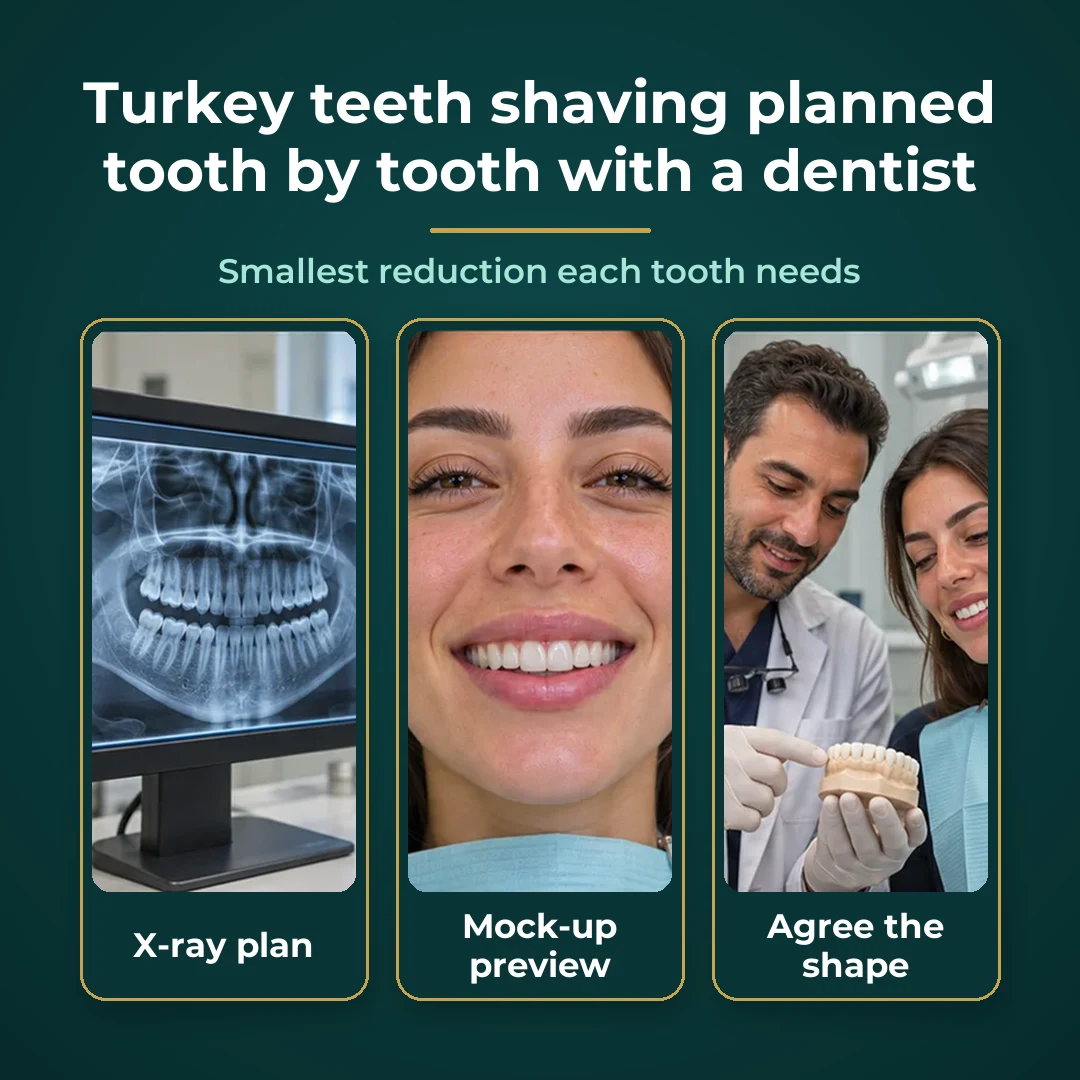
The real concern is healthy teeth being reduced beyond what the case needs. When we plan, we start from the smallest reduction each tooth needs instead of proposing crowns for every tooth. Ask any clinic how much of each tooth will be reshaped and why.
When Is a Crown the Right Choice and When Is It Not
A crown is the right choice when a tooth is broken, heavily filled, worn down or weakened after root canal treatment and needs full coverage. It is usually not the first choice for a sound tooth that only needs a change of colour or shape, where whitening, bonding or a veneer keeps more of the natural tooth.
A zirconium crown is a metal-free ceramic cover that suits teeth under heavy biting load, and our guide on zirconia or E-max compares the two main ceramics. A crowned tooth will always need a crown in future, which is why lifespan matters, and our guide on how long do Turkey teeth last goes through what studies report. Problems specific to zirconia are covered in our article on zirconia crown problems.
A crown usually makes sense for:
- A cracked or broken tooth
- A large old filling that is failing
- A tooth weakened after root canal treatment
A less invasive option, such as whitening or bonding, may be enough for a slightly yellow tooth, a small chip or a small gap.
How Do We Decide How Much Tooth to Prepare at Er Dental Clinic
We decide tooth by tooth, after an examination and X-rays, and we aim to remove only as much tooth as the chosen material needs. Your dentist looks at decay, gum health, your bite and any grinding first, then agrees the shape and shade with you before any tooth is reshaped.
A panoramic X-ray and, where your dentist needs it, a CBCT scan are part of planning. Digital smile design and a mock-up on your own teeth let you preview the proposed shape and length before any enamel is prepared.
You can start with a free online consultation. Send clear photos of your teeth, and any X-ray you have, on WhatsApp or through the contact form, and our dentists reply with a provisional plan and an estimated price. It does not replace an in-clinic examination.
Treatment is planned by Dt. Vijdan Aslanoğlu, a dentist who works on crowns and veneers at Er Dental Clinic, alongside our other general dentists. Our price list shows the per-unit price of each material, and you can read what patients say on our reviews page before you decide.
Ask Our Dentists About Tooth Preparation Before You Travel
If you are worried about how much of your teeth would be reshaped, send us clear photos of your teeth, and an X-ray if you have one. Our dentists reply with a provisional plan at no charge, and you can ask them anything before you decide.
Shaved Teeth Questions Patients Ask
Is it bad to shave your teeth for veneers?
It is not bad when the plan is careful and the removal is kept to what the veneer needs, but it cannot be undone. The American Dental Association notes that veneer treatment is not reversible because enamel is removed. Ask your dentist how much will be taken and whether a no-prep option could suit you.
Can shaved teeth be reversed?
No. Enamel does not grow back, and a tooth that has been prepared for a crown will need a crown or similar restoration in future. That is why a conservative plan and a clear explanation matter before treatment starts. A temporary crown protects the tooth between visits.
Are shaved teeth sensitive under crowns?
Often a little, for a short time. Prepared teeth can be sensitive to hot and cold, most noticeably in the first few days, and this usually settles by itself. If it lingers or you feel pain when you bite, tell your dentist, because it may point to irritation that needs checking.
How much tooth is removed for a zirconia crown?
It depends on the tooth, the material and how much sound structure remains, so no fixed amount applies to everyone. A thin layer is removed from all surfaces so the crown can sit over the tooth without making it bulky. Your dentist should explain the plan for each tooth before you agree to it.
Can you shave down just one tooth for a crown?
Yes. A single tooth can be prepared and crowned on its own if it is the only one that needs it, and your dentist confirms this after an examination and X-rays. The new crown is shade-matched to the teeth beside it, so the neighbouring teeth do not need crowns to match.
Do shaved teeth need a root canal first?
Not usually. Root canal treatment is needed when the nerve is infected or inflamed, which your dentist checks with an examination and X-rays before preparing the tooth. In that case it is done before the crown, not after. A healthy tooth does not need one just because a crown is planned.
References
- Veneers — American Dental Association (MouthHealthy), 2026
- Crowns — Oral Health Foundation, 2026
- Veneers — Oral Health Foundation, 2026
- Dental Crowns: Types, Procedure & Care — Cleveland Clinic, 2023
- Crowns (patient information leaflet) — Leeds Teaching Hospitals NHS Trust, 2025
- Clinical Outcomes of No-prep Veneers and Conventional Veneers: A Systematic Review — Journal of Contemporary Dental Practice (PubMed PMID 42607000), 2025
- Tooth structure removal associated with various preparation designs for anterior teeth — Journal of Prosthetic Dentistry (PubMed PMID 12070513), 2002
- Pulpal and Periapical Status of the Vital Teeth Used as Abutment for Fixed Prosthesis: A Systematic Review and Meta-Analysis — Journal of Prosthodontics (PubMed PMID 34516686), 2022
Related Pages
Get your free online consultation
Send us a short message with your question, and photos or X-rays if you have them. Our dentists review your case and reply with a personalised treatment plan — send it by e-mail or WhatsApp — your message is not stored on our server.
A short sentence is enough; no medical terms needed. What you write is only sent when you send it; this page stores no information.